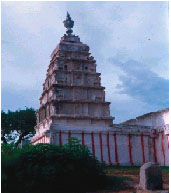
 One of my favourite places around Bangalore is Mahimapura, it is also the first place I visited alone on my bike. A quaint village with a small wooded hill one one side, this is one place I have never gotten bored visiting repeatedly. Friends whom I advised to visit the place also came back with similar experiences and loved the locale. I had written couple of articles about the place in Deccan Herald. The Garuda Ranganathaswamy temple in this village is actually the jewel in its crown. While the name may not be familiar, the locale is, at least for film buffs.
Mahimapura is an inconspicuous village located off Bangalore-Pune highway. Modern development may have eluded this place, yet riches of nature, culture and tradition are found in abundance, causing excitement among a few who stumble on it. Garuda-Ranganathaswamy temple, perched on the quaint-wooded hillock in Mahimapura, is the jewel in the village's crown. The priest here says this Vijayanagara-style temple is the only one of its kind, where Garuda, the vehicle of Lord Vishnu, assumes equal importance as his master.
Mahimaranganathaswamy, the temple's presiding deity, is a mound of jaggery believed to have evolved naturally. The Vishnu idol worshiped now is said to be installed during the Vijayanagara era. The 12-foot Hanuman statue enshrined in the temple at the foot of the hillock is also a spectacular sight.
A steep climb
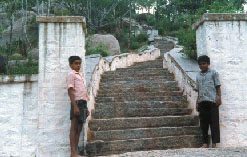
A steep 300 ft climb over the hill's well-hewn steps would lead us to the temple. Statues of Garuda, Hanumantha and Ranganatha (installed) are open for worship. The small structure has a square Garbagraha (sanctum-sanctorum); the Vijayanagar-style cubical pillars have carvings of leaves. The tall Shikara of the sanctum-sanctorum, built of brick, is visible from a long distance. The statue of Ranganathaswamy appears similar to the Venkataramana, with the Shankha-Chakra and Abhaya-Varadha attributes.
However, the temple in its entirety stands as an unfortunate contrast to the beauty of the deity. Many of the attractive carvings on the walls and pillars are fading due to lack of maintenance. The elegance of sculptures is spoiled by the whitewashing, rather inexplicably done for a granite structure. Prayer in the temple is conducted only in the mornings, as it's believed that divine saints visit the shrine after sunset. Despite its obscurity, Mahimapura might appear faintly familiar to some people, especially to the avid followers of Kannada films. The predominantly rural locale and the calm surroundings have triggered the imaginations of directors, who have made this the backdrop for the song-dance sequences.
The Legend
The legend behind Mahimapura though, is devoid of any such romance. Its here Garuda was on penance to purge the sin he had committed by eating the corpse of a Rakshasi (ogress). Aditi, wife of sage Kashyapa, receives two eggs from the Sun god, who tells her that two children will be born when the eggs are hatched. Aditi waits for several years and finally loses her patience, as the eggs didn't hatch. She breaks open one of them and a baby born from it without arms and legs curses her to lead a life of slavery and banishment. Afraid, Aditi prays to the Sun god, who assures her that the child born from the second egg would rescue her.
Years later, Garuda emerges from the egg and demands food from Aditi, who directs him to Sage Kashyapa. Hungry and impatient, Garuda interrupts the sage's penance and repeats his demand. The angry sage asks him to eat the corpse of the ogress. Doing so, Garuda realises his sin and seeks the sage's forgiveness. Kashyapa asks him to worship Sri Ranganathaswamy at Mahimapura to atone for his sins. After long years of penance, Lord Ranganatha appears before Garuda as Nirakari (the mound of jaggery).
The annual Jatra on the Maha Poornima day, which kicks off a fortnight of festivities, is an important occasion for the temple. The festival is accompanied by cattle fair. Rathutsava or car festival, which lures devotees from several villages, is also a major celebration at the temple. These apart, festivals like Janmashtami, Dasara (Navarathri) and Narasimha Jayanthi are also celebrated here.
Getting there.
Mahimapura is found 45 kms from Bangalore on NH 4 (B’lore-Tumkur road). At this point, a board with the village's name points left, towards a small diversion. Driving a kilometre and a half into the road would lead to the foot of the hill. The KSRTC plies three busses to Mahimapura in a day. It's also possible to reach the village by local transportation from Nelamangala.


 Al Ain sited close to the UAE-Oman border about 135 km from Dubai is attracting a large and growing number of leisure tourists who wish to take a break after a hectic shopping spree. Al Ain offers a plethora of rest and recreation opportunities, historical monuments, sports facilities and lots and lots of greenery. Naturally endowed with several large oasis’ Al Ain (pop. 500,000) is a green low-rise city sited in the shade of the Jebel Hafit mountains. Surrounded by awesome red sand dunes and the rugged craggy mountains, Al Ain is linked by excellent roads to Abu Dhabi, Dubai and Sharjah.
 Blessed with generous groundwater resources and self-renewing aquifers, Al Ain is one of the most fertile agricultural areas of the UAE, often described as the ‘garden city of the Gulf’. Indeed ‘Al Ain’ in Arabic means ‘spring’ and the region with its ancient but efficient non-mechanised falaj irrigation system boasts sprawling date and fruit plantations.
 The most popular tourist attraction here is the Al Ain Oasis. Sited in the epicentre of a cool date plantation and divided into numerous well-maintained date farms, the oasis is thronged by tourists who walk in quiet shades in lush greenery.
 Although Al Ain boasts over 42 forts, the best examples of Arab fort architecture are the Jahili Fort — a large restored fort structure with distinctive corner turrets; Mujairib Fort comprising a main and smaller fort, a 50 ft tall watchtower, surrounded by a park and children’s playground; Hili Fort with its ornate entrance and sprawling courtyard, Al Rumeilah famous for its sandstone architecture and the Murabba, and Mazyad forts.
 Most visitors from the subcontinent dazzled, by the malls and shopping arcades of Dubai and Sharjah don’t know it, but the UAE also offers exceptionally well-developed desert and water sports opportunities. For the sports-minded and adventurous, there are several options such as camel safaris, desert camping, sand and grass golf, dune bashing, etc. Popular indigenous spectator sports include Camel racing and Dog racing.