As a proud Indian citizen I continue to get frustrated by people who make the common mistake of using my ethnic-national identity label on others who are not even remotely connected to my country or ethnicity. It makes me wonder if there is even one individual out of the billion plus Indians who feel the same way about this issue.
Every so often things come up in the media that frustrate me to no end. One of the biggest that makes my skin crawl and blood boil is the issue of ethnic identity. Few million "Native Americans" in compliance with few million more Europeans and Africans continuously assault our identity. The first group have the audacity to continue to refer to themselves as "Indians" even though they know that they are not and for that matter never were the owners of the identity label. The second and third groups continue to foment the myth of Indian identity label for Native Americans. What is worse is the fact that over a million real Indians in the United States and a billion plus in the rest of the world are blissfully accepting this labeling without as much as a squeak of protest.
Recently I listened to a radio program on NPR presented by of course the famous Lourdess Garcia-Navarro, International correspondent based in Sao Paulo, Brazil, which was inappropriately titled "Brazil's Indians Reclaim Land Citing Promises, Using Force". Of course she is writing about the indigenous people of Brazil. In her biography page on NPR it is claimed that "Garcia-Navarro captured history in the making with stunning insight, courage and humanity." I wonder where this insight vanished when she is referring to Native Americans or whatever tribal nation they belong to as Indians. This reporter has been feted multiple times in various forums for excellence in reporting.
The reporting excellence seems to vanish when it comes to reporting the truth about Indians - of course the real ones from India and not those who are piggybacking on the label just because of a mistake made by Spaniard Christopher Columbus.
Thursday, August 15, 2013
Indians losing identity - or have we already lost it???


Sunday, December 04, 2011
Beading Designs
I am preparing for my final exams and of course what is the best way to take breaks. Create some new beading patterns which I might or might not implement in beads. I sure hope I will have the time and inclination to create them in beads/ seed beads during the winter break from school. For now here are the designs for evaluation by all my blog visitors and readers.


Thursday, November 24, 2011
Native American Beading Patterns
I wanted to take a break between studies for the upcoming exam on Monday, so I decided to get creative and here is the result. This is a pattern to make a beaded bracelet leaning toward the Native American style. Once my exams are over I will try to create it in beads and post some pictures. For now let me know if the designs are worth anything at all...


Saturday, July 02, 2011
NPR/ KERA repeats identity blunder!
Ever since I came to the United States, I have been disturbed by the fact that even after 500 odd years, the Euro-American majority have not begun to attempt to correct the historical error. i.e. the wrong identity label stamped upon the original peoples of this country/ continent from whom the Europeans usurped the land and built this glorious nation. These original people continue to be referred to as "Indians" even though everyone in the world knows that only those people from India can be referred to by this identity label. The original peoples should be referred to by their ethnic identity, such as Cherokee, Chickasaw, Comanche, etc. There was not one or two such distinctly different ethnic groups but more than 700 before the first Europeans even stepped on this land.
Recently I was listening to National Public Radio while commuting to work and I hear about this important Native American ceremony. The news report was about the first peoples of this nation commemorating the birth of a White Buffalo Calf. The news report started off politically correct by referring to these people as "Native Americans" but as the story progressed it changed once again to refer to them as "Indians".
I wonder how many more centuries these Euro-Americans will take to realize that they need to correct their erroneous identity labels. More than that I am amazed at the billion plus Indians in India and the few million Indians in the United States of America who are silently watching this historical blunder repeat itself again and again. I don't know whether people from India are even aware of the misuse their ethnic identity is undergoing.
I know being one individual I can't fight the system that has been established for over 500 years but I can make my protest to this gross misuse of my ethnic identity label to refer to someone who is not even remotely associated to my culture, nationality, or ethnicity.
Wednesday, March 09, 2011
Smart, Business Savvy, But Unaware or Callous???
I continue to blog about the gross injustice the western world is inflicting on easterners... particularly people from India. First when people in the US or Europe say "Asian" or "Asia" they mean "China". This is a recent phenomenon since the west began to access cheap goods produced by slave labor in China.
What I am blogging today is about a greater and more historical injustice that continues to go unnoticed in the greater consciousness of the entire Western world and almost everyone in the Eastern world also. This is the identity mistake that has endured since the past 500 years and has not been corrected despite the arrival of the internet that has ushered in the information age and created knowledge explosion.
Yes I am talking about the identity label of "Indian" being hijacked by people of "Native American" tribes. Today I listened to a radio program titled "Smiling Indians" on NPR. Quite predictably this program spoke about the Native Americans or the original inhabitants of continental America, most of whom were massacred by the European settlers when they started colonizing this continent.
Well I understand that Christopher Columbus was totally mistaken when he landed here and discovered the new world for Europeans to exploit and conquer. But isn't it high time for the world to recognize that these people are not "Indians" but are whatever nations they profess to belong to.
I am amazed by the fact that these "Native Americans" are also not standing up to claim their true national/ tribal identity and are piggybacking on the "Indian" identity label. How much longer will they remain oblivious of their own roots and compromise their ethnic identity for the collective label often used in a derogatory sense: "Indian".
I am totally shocked that the fairly influential and large Indian diaspora living in the US since the past several decades have quietly accepted the title of "East Indians" and allowed their true identity to be pegged on to the Tribals of America. I wonder when these people: Indians and Native Americans will get educated and start labeling themselves correctly.
I hope this happens in my lifetime.... or is it too much to hope for???
Thursday, February 17, 2011
Proud to be an "Indian"!
In my three years of living in the US I have come across people from several nationalities, cultures, and ethnic groups. One thing I have noticed is that the people who are the most proud to be "Indian" or "part Indian" are not people from the great nation of India. In fact they are not even remotely connected by family or heritage ties to the nation of India. Can you guess who these people are and why they are claiming to be "Indian"?
Yeah, you guessed it right. These are "White People" or "Euro Americans". I have come across several of these people who are "as white as they get" and they say "I'm 1/8th Cherokee Indian" or "My great-grand father was Navajo Indian," or "I have some Indian ancestry," etc. When I hear such comments I wonder about the rationale of their observations. Knowledge, Education, and technology has connected the world and made it a global village, but have failed in correcting the gross historical mistake in the consciousness of the Euro-Americans... including the Spanish-Americans. When I say Americans here I am talking about the Citizens of all nations of both North and South America.
History is evidence to the fact that Christopher Columbus set out looking for a route to India and thanks to pathetic navigation skills he landed in South America instead of India. The people he saw there he thought they were Indians because he was sure that he reached India. We all know this but over the past five hundred years people have become aware of the stupidity of Columbus, but they haven't felt the need to correct the historical mistake. This includes common people, highly educated academics, government officials, and the people affected.
There are two distinct groups of people who are affected by this false nomenclature or identity tagging. The first of course is the "Native American" or "First Nations" peoples who have their own distinct tribal/ national identity of being a "Cherokee", "Choctaw", "Navajo" or whatever which is completely lost under the common umbrella of "Indian" or "American Indian". Second group which is affected to a greater extent is the real Indians, i.e. people from the world's most spiritually advanced Nation of India. We have been unnecessarily branded as tribal with no refined culture, science, education or nationality by getting equated to these "Native Americans".
It is surprising that there has not been any organized movement from either groups to correct the historical blunder. The Native American people seem comfortable with the identity label of "Indian", as evidenced by the names of their organizations such as "American Indian Chamber of Commerce" "Bureau of Indian Affairs" etc. The people of India are so naive that they don't mind sharing their ethnic identity label with anyone and everyone in the world even if it means accepting a derogatory name, listening to insulting comments and having their ethnicity challenged.
The people who made the mistake don't care because they can't admit that their ancestors were at fault. It hurts their ego. Also by branding people from India as tribal they can assert their own Euro-Supremacist identity and attitude.
I wonder why everyone is silent to this historical blunder. I don't expect anything from academics because they have always historically been involved in finding ways and means to brand India as a nation full of tribal, superstitious, stupid, slave-like peoples. But I am appalled by the way Native Americans have let this identity label be applied to them even in this age of awareness. I wonder why they have not asserted their own national identity. They can stress that their heritage is "Cherokee, Navajo, Apache, Comanche,... etc" instead of adding the "Indian" suffix to their nation's name. By doing so they are actually diluting their own national pride and respect to their nation. People from India, their complacence in handling issues of national identity, civilization pride and respect make me wonder.
I believe that it is high time everyone stepped in to correct this historical blunder and stop being stupid. Teachers, academia, government, media, and most importantly the people should resolve these identity conflicts so everyone can be at peace and not confused.
Thursday, March 25, 2010
Bureaucracy and Red Tape is same everywhere in the world!!!
When I was in India I would often be bewildered and frustrated by the way government functioned. The way center and states fought with each other and bureaucrats hindered the work. The end result would be to slow down the over progress of the nation. I was under the impression that this kind of tussling and infighting happened only in nations like India where there is enormous diversity in culture, language, religion, traditions, etc.
Boy, was I wrong... this seems to be the norm everywhere in the world, even in the supposedly most developed, richest, and powerful nation in the world - the US. Recently I heard a news item on KERA, a member station of National Public Radio that confirmed to me beyond doubt that bureaucracy and red tape most often hinder a nation's progress because of their obstinacy to follow rules by the letter.
Illegal immigration has been a problem of this continent since the first ship landed from Europe, bringing hordes of white people who massacred and decimated native populations to establish what is known today as the United States of America. This post is not about that historical illegal immigration, but about the recent issues since the modern democracies were established across the world post World War II. States of the US bordering Mexico, Texas, Arizona, New Mexico and California, have the largest influx of illegal immigrants historically.
The Federal government has been attempting to stem this influx by putting in place several measures that included installation of border fences, employing border patrols, deporting illegal immigrants, etc. At local government level one Texas city attempted to discourage illegal immigration by passing a law that prevented land lords from renting properties/ homes/ apartments to people who don't have legal standing to stay in this country. Logically speaking I would have expected the Federal government to applaud this measure and encourage other cities to pass similar laws.
Unfortunately this didn't happen, on the contrary a Dallas Federal Judge struck down this law on the grounds that controlling illegal immigration was the job of federal government alone. This sends out a serious message to the people in local governments and also to the illegal immigrants. The latter rejoice because now even if a local government official is aware of their status, he/ she can't do anything about it, only the federal government can take action.
Taking the judges logic to its extreme I wonder if common people should keep quiet if they see a crime taking place. Fighting the crime is the job of Police, so citizens should just report and watch quietly as the incident takes place. I would like to know other people's opinions on this.
Sunday, December 20, 2009
Walnut Canyon continued....
The ancient peoples that lived in Walnut Canyon continue to haunt me and I would like to write a little more about them. Looking at their homes, and the surroundings I would conclude that they lived in perilous, hostile and rough areas. The Canyon was surrounded by wilderness and they pretty much built homes on the steep slopes of the canyon. Far below in the valley bed is the flowing river which is the only source of water for these people. To get their regular meal they had to struggle and work hard cultivating corn and hunting in the wilderness. Water had to hauled up from the stream below. I am sure the community lost some of its members because of accidents, they would have just fallen off the path into the ravine and gotten washed away in the river.
Anyway coming back to this post I would like to present some pictures of the steep slopes where the homes were built. A cursory look at the image would not reveal any dwelling/ construction. This I guess provided them a natural camouflage. Look at the pictures and see if you can identify any of the ancient homes.


Tuesday, August 04, 2009
Ethnic Identity Crisis for the original inhabitants of the US
I have been cribbing about the fact that the original inhabitants of Continental America are being erroneously referred to as "Indians" leading to lot of confusion and humiliation to us the people who truly have right for this ethnic identity title. Recently for my class project I took up this subject and reviewed three scholarly literature sources. I thought I would share it with the readers of my blog and elicit your opinions on the subject.
Indian, American Indian, Native American, and Alaska Native: Which Is The Right Ethnic Identity For The Indigenous Peoples Of Continental America?
Ever since Christopher Columbus landed in Continental America in 1492 in his search for India and erroneously called the indigenous peoples of this continent as Indians, the racial and ethnic identity label has persisted (Robert F Berkhofer Jr. 4 quoted by Bird 5). Though it has been five centuries since and the world has become aware of Columbus’ erroneous perception of the real identity of indigenous peoples of continental America, the federal and state governments, media, and academia in the US continue to refer to them as Indians. In fact there is a Bureau of Indian Affairs under the US Department of Interior to provide services to the people of indigenous descent. Over time this identity label has evolved to include terms such as American Indian, Native American, Amerindian, Alaska Native, among others, but none of them are correct. This persistent erroneous nomenclature of the indigenous peoples of US by everyone including the government has led to great deal of confusion. In this conundrum of identities the fact that people from India are the rightful owners of the identity title Indian, Indian American and American Indian (the last two refer to Indians who have immigrated to the United States) has been totally ignored.
To learn more about this ethnic identity crises and understand what the indigenous peoples of continental America feel about being referred to as Indians, I have chosen three scholarly journal articles on this subject. These articles attempt to resolve the identity crises of the indigenous populations of continental America and arrive at a suitable acceptable ethnic identity label. In the first paper titled What We Want To Be Called: Indigenous Peoples’ Perspectives on Racial and Ethnic Identity Labels, Michael Yellow Bird attempts to define the right ethnic identity title for the entire population of indigenous peoples. In Renaming Ourselves On Our Own Terms: Race, Tribal Nations, and Representation in Education, Cornel Pewewardy makes a strong case for self determination of identity for indigenous peoples and moving away from titles thrust upon them by colonizing Europeans. Carole L. Seyfrit, Lawrence C. Hamilton, Cynthia M. Duncan and Jody Grimes discuss how ethnic identity influences the aspirations of youth of indigenous populations in Alaska in their journal article Ethnic Identity and Aspirations among Rural Alaska Youth.
What We Want to Be Called: Indigenous Peoples' Perspectives on Racial and Ethnic Identity Labels, focuses on the fact that the terms “First Nations Peoples” or “Indigenous Peoples” should be the new ethnic identity labels of the indigenous populations of United States. The article rues the fact that the terms “Indian” and “American Indian” are the current identity labels simply because they were “uncritically imposed” upon them by colonizing Europeans (Bird 3). Further in the article the author explains why it is difficult to group the entire indigenous population under one identity and makes a serious attempt to arrive at a consensus about the type of nomenclature that would appropriate to refer to the unified mass of indigenous peoples of continental America.
The title of the article suggests that there are several members of the indigenous peoples speaking out in favor of self determination of their ethnic identity. Given that there were more than “560” unique groups of indigenous peoples each with their own ethnic identity label before the colonizing Europeans arrived it is understandable that they do not wish to be placed under a blanket ethnic identity label. Moreover current terminologies in use including “Indian”, “Native American”, and “American Indian” are colonized identities (Bird 6). The authors feels that there is a dire need to move away from these stereotyped identities and define their own unique and empowering ethnic identity label. The title also indicates that the author is quite unhappy with the current terminology used to identify him and his community and wants to change this identity perception.
A clear problem statement with a detailed explanation about the social, economic, and historical context is made right at the beginning. The fact that the First Nations people or indigenous people are not a uniform group but belong to over “560 distinct tribes, including 233 Alaska Native villages” is one of the strong reasons given by the author to prove that they should not be grouped under one ethnic identity label (Bird 4). Popular media has also used the terms “Indian”, “American Indian”, “redskins”, “savages” in demeaning manner (Bird 6). He rues the fact that this kind of labeling creates stereotypes which has led to the people of First Nations being frowned upon as those who are not ready for modern civilization. “Because these labels have an overwhelming negative effect on the identity of all Indigenous Peoples and can institutionalize feelings of racism and discrimination toward these groups, many Indigenous Peoples have spearheaded efforts to call for the end of using these labels” (Bird 5).
One of the popularly accepted ethnic identity label which has become prevalent during the second half of the 20th century is Native American. This identity would include anyone born in continental US and as such not acceptable. Speaking about this identity label, the author successfully argues against it. “While the label ‘Native American’ may not have the baggage of stereotypes associated with the term ‘Indian’ it still reflects a monolithic identity of Indigenous Peoples and gives the impression that these lands were referred to as ‘America’ by its Indigenous Peoples, which, of course, they were not,” (Bird 5).
Reading this article I get the impression that there have been several attempts by educated people of indigenous heritage to get rid of the racially discriminating and demeaning ethnic identity label imposed by colonizing Europeans and Americans. One of them has been spearheaded by the author himself. He cites his experiences of using different identities in order to resist the designs of colonial powers to impose an oppressive identity upon all the indigenous peoples. He feels that the terms “First Nations Peoples” and “Indigenous Peoples” can be used to replace the racially demeaning identity labels (Bird 7).
The primary sources of information for this article are members of the members of Association of American Indian and Alaska Natives Professors (AAIANP), who are professors, graduate students or faculty members of various universities in the US. I think this makes the article unique because all respondents are of indigenous heritage. The respondents were asked four discussion questions by electronic mail and their responses analyzed to arrive at the conclusion. According to the author though the questions were sent to 107 members out of a total of 345, only 19 responded (Bird 8).
In matters such as this it is important that a large number of people are interviewed to find out the collective opinion. This particular research paper’s main weakness is that there are too few respondents and as such it is difficult to establish credibility to the findings. Since the number of respondents is so low, this research runs the risk of not being taken seriously. A point the author also concedes: “The opinions reported in this paper have several limitations and cannot be generalized to the general population of Indigenous Peoples or members of the AAIAN” (Bird 8).
At the very end of the article the author comes to the conclusion that the identity label “Indian” rightfully belongs to the people of India as corroborated by a large majority of the respondents. Though many of his primary sources accept being called Indians or American Indians just because it is a term used since several hundred years and has become an accepted norm, the author concludes the article by saying that the “what is most important in the struggle to define racial and ethnic labels are representative of Indigenous Peoples is that these groups do not lose their identities as the First Nations of these lands.” (Bird 19)
I feel that this article is a significant work in the realm of ethnic identity of the indigenous peoples of continental America. The author has successfully defined who is a member of the First Nations and who is a Native American and why these people should not be called Indians or American Indians. This is a pioneering attempt to involve indigenous peoples to define their ethnic identity and will serve as a reference to academics, researchers, minority groups of first nations and true Indians living in the United States.
In the article titled Renaming Ourselves On Our Own Terms: Race, Tribal Nations, and Representation in Education, Cornel Pewewardy uses quotations from several eminent people of indigenous heritage to drive home the point that self determination of identity and moving away from racially demeaning stereotypical titles thrust upon them by colonizing Europeans is the only way forward. This treatise is written more like a personal memoir interspersed with serious facts and quotations. The author starts the article by stating that Columbus not only started the process of colonization of continental America but also represents the legacy of suffering inflicted upon indigenous populations and destruction of their cultures (Smith cited by Pewewardy par. 1).
The mechanics of European colonization of continental America lead to imposition of racially demeaning identities to cover the entire mass of indigenous peoples of the continent. In a bid to completely subjugate the indigenous populations the colonizers resorted to dilution and sometimes destruction of their heritage and culture by imposing foreign identities and ways of life. Within the first few paragraphs the author makes it clear that this article has been written to discuss the themes of linguistic imperialism, race, tribal nations and their representation in education, and tribal identity (Pewewardy par. 3).
Like Bird in the previously cited article, Pewewardy also toys with the several different identity labels used in popular media to define the indigenous peoples of America and comes to the same conclusion that none of the ascribed terms, Indian, American Indian, Native American and Amerindian were right and gave the impression “as if we had no power to define other choices” (Pewewardy par. 4). He successfully argues that these identities denote nothing but negativism. As if on retrospective thought the author seems to praise the fact that some academics have evolved identity labels which such as “First Nations People” and “Indigenous peoples” which denote positive meanings and respectable identity. The author expresses happiness that “some tribal nations have started to tribal nations have started to take back their original names for themselves: Diné (formerly Navajo); Ho-Chunk (formerly Winnebago);” (Pewewardy par. 5).
The next section of the article starts off with a number of quotes on the subject from academics of indigenous heritage. I feel that Pewewardy is using these quotes to try and make his case stronger. If the author had have limited himself to quote only the most significant ones, it would have a made a better impact. Further on the author rues the fact that most indigenous peoples seem to have forgotten that they had distinct names, based on history, heritage, cultural bonds and thousands of years of tribal learning. All of them destroyed by influx of colonizing Europeans who with their implicit and explicit superiority complex subjugated and oppressed the indigenous populations. “many tribes forgot the origin of their names and also how, as Indigenous Peoples, we came to be given alien English names by people outside our tribes” (Pewewardy par. 16).
There seems to be some kind of a discrepancy between the title of the article and the subjects covered within. When I read the title I expected the article to deliberate about ways and means of how indigenous peoples of the United States can arrive at an acceptable identity labels for their race, nation and how the same can be represented in education. While the bulk of the article deals with the subject of defining racial and tribal identities, there are large sections which discuss things such as linguistic imperialism, cultural hegemony and racism. I feel the article should have been titled better to reflect these subjects too. Discussing the difference between race and ethnicity the author emphasizes that “Ethnicity implies history, culture, location, creativity” (Obinga quoted by Pewewardy par. 48). On the other hand the author rues the fact that oppressive European powers have confused the indigenous populations with the concept of race and color and made them forget their ethnicity and tribal identity.
Towards the conclusion of the article I get the impression that the author seems to be confused as to what the future holds for him and his people. He also goes into a preachy mode and exhorts his tribal brethren to “cleanse our thinking of gross error” and apply themselves to appropriate systems and structures and support a healing process for affected tribal families (Pewewardy par. 61). It appears as if the author is trying to make an attempt to bring all the indigenous populations within one umbrella identity but loses his tracks along the way and towards the end tries to regain tracks again. I believe that this article’s strength lies in its effective delineation and discussion of a wide array of tribal issues with a clear focus towards the future. This article is a must read for the 1.6 million indigenous peoples in the United States (BIS par. 1). It could also prove to be a useful resource for researchers, students and faculty members of sociological and anthropological studies departments in universities and colleges.
The third journal article I studied for this paper is titled: Ethnic Identity and Aspirations among Rural Alaska Youth and has been written by four researchers Carole L. Seyfrit, Lawrence C. Hamilton, Cynthia M. Duncan, and Jody Grimes. This article is a result of “survey data from adolescents in 19 rural schools to explore relationships between ethnic identity and students' expectations about moving away or attending college” (Seyfrit 1). What I found unique about this article is that this not only speaks about the ethnic identity of the respondents but successfully links it to their perceptions of life, education and career. The authors of this article seem to view the people of Alaska as “Eskimo, Indian or Aleut” but the respondents define themselves as “mixed, native or non-native”.
The authors begin the article by giving an overview of the socio-geo-economic picture of the arctic state, explaining how difficult life is out there and facts about the sparse population of the region. The authors explain that “although Natives comprise less than 16% of the state's population, they make up 54% in communities having fewer than 1,000 people. Many villages are more than 90% Native” (Seyfrit 3). Here again the authors don’t even attempt to make a distinction between the different groups of indigenous peoples but include them under the umbrella of “Indians”.
In primitive labor-oriented societies it quite natural that native youth prefer to take on their ancestral family occupations and continue to live in the same area. It does not need special education or college degrees to learn their family trade; on the other hand descendents of non-natives would tend to be drawn towards white-dominated urban locales. “That is, ethnic identity might affect youths' image of where they belong and what they should do” (Seyfrit 4).
This article essentially focuses on the educational accomplishments of native versus non-native youth and provides tables and charts to present their findings. The most relevant section of the article to this study is titled Ethnic Identity. This section basically discusses how the construct of self-identity and ethnicity has come about in rural Alaska. “That is, ethnic identity might affect youths' image of where they belong and what they should do” (Seyfrit 9). Like in mainland United States, there exists a great deal of ethnic complexity in rural Alaska. The government has provided individuals with a set of mutually exclusive categories to arrive at their ethnic identity. “An individual might be identified, or asked to self-identify, as either an American Indian/Alaska Native or as a member of some other category such as Hispanic or white. Of course, many people actually have mixed ancestry” (Seyfrit 9). The authors discuss the fact that there have been so many mixed marriages that arriving at the correct ethnic identity of children born out of these unions are very difficult. According to the results of a 1995 survey presented in a well organized table 62% of the respondents identified themselves as Alaska Native (Aleut, Inupiat, Yupik, etc). These identity constructions are quite contrary to what is recorded in the US census records. The author cites instances where several students identified themselves as people of mixed heritage while the records classified them as “Native” (Seyfrit 10). This leads to a lot of confusion in the minds of these youth about who they really are.
The main strength of this article is the fact that the results of the survey conducted among the youth of rural Alaska are presented in a very reader-friendly and easy to understand manner. The authors employ charts, tables and graphs to present their findings and make their observations. The survey results are compared with the official records and the discrepancies in the ethnic identity are exposed to the reader. The title makes one feel that this article is a deliberation about the construct of ethnic identity and how it affects the aspirations about the future of youth of rural Alaska. The article is actually a quantitative study and analysis of the education, career and future aspirations of youth of rural Alaska. The question of ethnic identity is discussed in a very minor form in the article and as such doesn’t do justice to the title of the article.
Reading these three articles I came to the conclusion that the ethnic identity of the indigenous peoples of continental America is indeed a serious issue. The native or indigenous peoples are quite resentful about being branded as Indians, American Indians or any other blanket identity imposed upon them by colonizing Europeans and Americans. It is surprising that I didn’t come across any discordant voices of true Indian academics about the compromising of their ethnic identity. Towards the end of my reading and analysis I understand that both Indians from India and the indigenous peoples of America are unhappy with the fact that the European and American colonizers have held on to the erroneous ethnic identity while referring to the latter. Perhaps the small minority of academic voices is not enough to make the government and media listen and take action to let the indigenous peoples arrive at their own ethnic identity label.
Works Cited
Berkhofer Jr. Robert F., The White Man's Indian: Images of American Indians from Columbus to the Present. New York: Vintage, 1968.
Bird Michael Yellow, “What We Want to Be Called: Indigenous Peoples' Perspectives on Racial and Ethnic Identity Labels”. American Indian Quarterly, Vol. 23, No. 2 (Spring, 1999), pp. 1-21
Pewewardy Cornel, “Renaming Ourselves On Our Own Terms: Race, Tribal Nations, and Representation in Education”. Indigenous Nations Studies Journal, volume 1 No. 1 (Spring 2000).
Seyfrit Carole L., Hamilton Lawrence C., Duncan Cynthia M., Grimes Jody, “Ethnic Identity and Aspirations among Rural Alaska Youth”. Sociological Perspectives, Vol. 41, No. 2 (1998), pp. 343-365.
Smith, L.T. Decolonizing Methodologies: Research and Indigenous Peoples. New York: Zed Books 1999.
Monday, August 03, 2009
Indians or Native Americans or First Nations Peoples
This picture is a classic example of how the west is using the term "Indian" to denigrate us, the people from India. There are signages around this ruin which says that this is an "Indian Dwelling". A bunch of stones placed unevenly around is an "Indian Dwelling", they are far from the truth. The truth is in this other picture which is the "Indian Dwelling" in India.
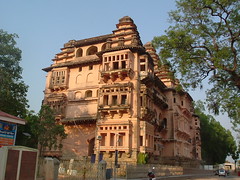
I wonder how many centuries it will take for the European-White-Dominated US Government, media and society to realize that Indians are the people from India and the original inhabitants of this continent are "First Nations Peoples".
Tuesday, July 07, 2009
Grand Canyon - Ruins
Grand Canyon is not all about nature and its wonders. There are many reasons to visit this natural world heritage site. Being an ardent traveller, nature lover, history enthusiast and an individual who intimately feels for the oppressed populations, I have a lot to look out for in the Grand Canyon. The first is of course, the natural beauty and the adventure possibilities the canyon offers.
Everytime I visit any historical location in the US. Everywhere, an intense sense of rage and frustration descends upon me because of the terminology which is used by the government/ national park service folks. There is a constant drumming of the fact that there were "Indians" or "American Indians" or "Native Indians" here before the Europeans landed and took over the country. This is grossly wrong, there were large native populations in this country and each one had their own nation, such as Apache, Choctaw, Hopi, Pueblo, Comanche, etc.
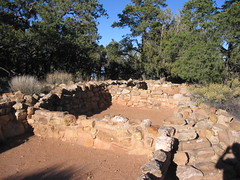
I'd like to present this picture of a ruins of a settlement in the Grand Canyon. According to some signage, this picture depicts the dwelling of some Native American tribes during 1,000 BC. Of course the signage says "Indian" while refering to the tribes. I understand that 500 years ago when Columbus landed here, he thought he had landed in India and called the people Indians. But since then the world has changed, there has been knowledge explosion thanks to the internet and other communication technologies. Despite these changes, the only thing that seems to persist is that "Native Americans" continue to be called "Indians". I can only infer this mis-nomer as an effort to degrade us, the real Indians from India.
Way back in 5,000 BC India had a glorious civilization and much more advanced society in terms of urban development, roads, art, architecture, culture, language, metallurgy, etc. Some of which have not been replicated to this date by any other civilization... not even the so called "Scientifically Advanced" first world nations. But these people continue to misrepresent India and our people in various forms. Be it in history or in the media such as the recent Oscar-awarded movie "Slumdog Millionaire" and the people who consume such media happily believe this.
I wonder when the "West will Learn".
Monday, February 09, 2009
Fort Richardson - The site of Native American-European conflicts
I haven't been able to blog for quite sometime, since I have been caught up with academics. But here goes a brief blog about Fort Richardson which I visited about 10 days ago. Fort Richardson State Park, in Jacksboro, Tx, sited about 85 miles from DFW Metroplex, is one of those places where one can experience the real wild western side of Texas. These are places which very few people outside US would have heard about, much less visited. According to local history and the information available at the "Park Interpretative Center" this was apparently the site the very bloody "Indian Wars" (I would call it "Massacre of Native Americans by Colonizing White people").
When I heard about Fort Richardson, I imagined that there would be a fort like the ones we find in India. High ramparts with several bastians surrounding the perimeter of the fort and canons all over. But when we finally got there after meandering our way through miles and miles of empty flat lands I was pretty disappointed to know that there was no fort indeed. It is just a vast open space like any other plain in Texas with a few old (less than 200 years) buildings.
But I must give credit to Texas Parks and Wildlife who have made this place worthy of a picnic, hike and outing in general. There are hiking trails with boulders which could be explored, the creek which slices through the terrain leads to a dam where one could enjoy a swim during the hot Texas Summer months...
This is definitely not the place for those who seek history... it is only a place to feel the vastness of Texas and enjoy hiking in the wilderness. Some of the remaining buildings of the Fort are posted below.
Entrance to the Park

The interpretation center which also houses a small museum

Hospital building - where wounded white soldiers were cared for - there is a morgue behind it also

The Bakery of the Fort

Another picture of the Hospital

The Guard House - or whatever remains of it

This place was a limestone quarry, now filled up with rain water

Quarry lake - another view


Sunday, August 31, 2008
Fort Bowie, Arizona
During our road trip to Los Angeles we stopped by at Fort Bowie in Arizona. This used to be one of the key links in the days of rail road and when the white European invaders were fighting the Native Americans in a bid to take possession of this continent-sized country. Getting to Fort Bowie involves a 1.5 mile walk through a open grassland surrounded by mountains and one has to ford couple of streams too. Paucity of time prevented us from getting to the actual fort but nevertheless we did about 0.5 miles on the trail and retraced our steps. Here are some pictures of Fort Bowie trail.. 
At the beginning of the Fort Bowie Trail
According to the official site of Fort Bowie National Historical Site, this was the location of immense military action and a location which commemorates the "bitter conflict between Chiricahua Apaches and the U.S. military - a lasting monument to the bravery and endurance of U.S. soldiers in paving the way for settlement and the taming of the western frontier. It provides insight into a "clash of cultures," a young nation in pursuit of "manifest destiny," and the hunter/gatherer society fighting to preserve its existence."The site further states that this site was the center of military operations between the Native Americans and the European Settlers. Quite expectedly the ill-equipped and simple native americans couldn't stand for long against the well equipped and cunning European forces who forced them to surrender in 1886. Did the Europeans leave the surrendered Native Americans alone? No way, in a bid to further humiliate them and alienate them from their land, the Chiricahuas were banished from Arizona to Florida and Alabama.
If I were to inherit this kind of legacy of ruthless murder, plundering and displacement of natives to take over their land and natural wealth to build settlements, I would be totally ashamed of my history. But here this kind of practice of annihilating entire civilisations, cultures and tribes is celebrated and praised. No wonder these people didn't bat an eyelid while dropping the Atom bomb on Japan during WW II or battering up Iraq recently or supporting Islamic militancy in Afghanistan, Pakistan and other parts of the world.
Anyway coming back to Fort Bowie and its serene nature friendly surroundings. Sited in the southeast corner of Arizona state, Fort Bowie's trails range from 4,550 to 5,250 ft asl, and hosts over 65 mammal, 30 reptile and 150 bird species in the area. The trail passes through tall hills and the vast plains are careted with bushes, shrubs and grasses. The entire national park area hosts 471 plant species including several uniquely different flowers, cacti etc. The highest point in the mountain range and national park is a mountain known as Helen's dome. This is a granite rock formation which was used as landmark by travellers during olden days to guide them to the fort.
The entire area is overrun by several streams which run during monsoon and dry up in the warm summer months. There are numerous boards which warn visitors not to go ahead if it is raining or if the road is flooded etc. Apparently when water flows it is quite dangerous.

The first stream which we crossed enroute Fort Bowie

Another stream crossing, there are boards advising people to turn back if these streams are flowing in full capacity

Beautiful flowering plants dot the trail

Arizona is the state of cacti and this is one of the unique varieties found here

Trail facade.... long way through the wilderness to Fort Bowie

Bright yellow flowers cheer the visitors soul

Another uniquely different cactus plant

A 100% dried up tree on the trail

Remains of old buildings along the fort bowie trail

Overview of the Fort Bowie Trail