Every once in a while I come across strange and often shocking news, which illustrate the worse-than-beastly character of human beings. According to an article I read a 14-yr-old girl was imprisoned in the bathroom of a residence by her father and step-mother because she had allegedly stolen some food and cheated on a home school test. Locking her up, beating her with metal rods and making her exercise was the punishment. This has been going on for the past two months.
Come on guys she is 14 and as all teens are I guess she has a robust appetite. She must have eaten some food from the refrigerator between meals. Why home school her when there are wonderful schools in the US. For god's sake, you are not living in some underdeveloped sub-Saharan African nation. This guy is living in US of A, the world's richest nation. Same goes for food. Food wasted in the US can feed 27 small nations in the world. So there is absolutely no food scarcity.
I think this man is simply sick.. mentally ill. He and his wife should be safely locked up and the girl should be adopted by someone who really cares for her well being. But in this country where lawyers are more powerful than justice, will this happen?
Wednesday, February 10, 2010
Shocking News: Parents Imprison Teen girl in bathroom


Thursday, December 24, 2009
Vistas of Meteor Crater
Yesterday I blogged about our visit to Meteor Crater and how the private owners have created a swank shopping and educative space in the desert. This is a very successful business model which benefits the individual, visitors and the government. The individual owner of the property preserves, maintains, and promotes the place. Visitors get the opportunity to learn about meteors and other space phenomena and the government gets its taxes. It is a win-all situation from all aspects.
Here are some more pictures of the Meteor Crater. I wish they would allow visitors to go down into the depths of the crater, but since they have done some mining in the past looking for precious metals at the site of the meteor fall, they are little wary of letting people inside the crater. For now visitors have to content themselves looking over the rim of the crater and the museum does offer some guided hiking tours which take visitors half-way round the crater.


Tuesday, December 22, 2009
Meteor Crater, Arizona
Meteor Crater in Arizona is one of the largest craters in the world formed as a result of impact of meteor showers. Surprisingly this crater is not a government owned national monument, but a privately held museum which offers tours, and allows visitors to look around for a fee. One good thing though is that the private owners of this crater have not modified it or exploited the land for commercial purposes. The location continues to be one huge crater located amidst the rugged desert/ arid state of Arizona in the US. This location has been used by the NASA to train astronauts in the past. There have been allegations that the original moon landing by Neil Armstrong, et al was a hoax and that it was filmed here. I don't know about those conspiracy theories, all I know is that I visited this huge crater and stood on its periphery. The attached exhibition is a great place to learn about space explorations, meteors and comets. It would be a great place to take kids to educate them in a fun filled way about space.

Monday, December 21, 2009
Walnut Canyon: The Grand Finale
I have posted three blogs about Walnut Canyon and I am pretty sure some of you may be quite irritated about it. Anyway here are the final set of pictures I would like to share with you all about Walnut Canyon, next we will talk about Meteor Crater in Arizona, which is famous among many "Moon Landing Fake Theorists" as the location where the entire moon landing was filmed. Anyway that will come later, for now let us look at few more pictures of Walnut Canyon.


Sunday, December 20, 2009
Walnut Canyon continued....
The ancient peoples that lived in Walnut Canyon continue to haunt me and I would like to write a little more about them. Looking at their homes, and the surroundings I would conclude that they lived in perilous, hostile and rough areas. The Canyon was surrounded by wilderness and they pretty much built homes on the steep slopes of the canyon. Far below in the valley bed is the flowing river which is the only source of water for these people. To get their regular meal they had to struggle and work hard cultivating corn and hunting in the wilderness. Water had to hauled up from the stream below. I am sure the community lost some of its members because of accidents, they would have just fallen off the path into the ravine and gotten washed away in the river.
Anyway coming back to this post I would like to present some pictures of the steep slopes where the homes were built. A cursory look at the image would not reveal any dwelling/ construction. This I guess provided them a natural camouflage. Look at the pictures and see if you can identify any of the ancient homes.


Saturday, December 19, 2009
Views of Walnut Canyon, Arizona
I introduced Walnut Canyon in my previous post and how it was a thriving settlement of Native Americans during the 1200s. In this post I would like to present images of the buildings in which these early peoples lived. The way they innovated and used natural rock surfaces as walls and roofs and built just one wall to create a home amidst the most hostile and precarious surroundings. Here are a few examples of the homes and dwellings of Native Americans in the Walnut Canyon of Arizona.


Friday, December 18, 2009
Arizona's Walnut Canyon
When I was in India America/ US meant couple of things such as New York, Los Angeles, Grand Canyon, Niagara Falls, etc. Till the time I landed here I hadn't known that there exist several natural, historical and heritage locations in this country. I got first hand knowledge about this conglomerate of states when I first traveled from Los Angeles to Dallas stopping at several interesting locations enroute.
One of the locations we stopped at was Walnut Canyon, a narrow and deep gorge like valley in the middle of Arizona. This was the site of large native American settlement as recently as 1200 CE. These native Americans were either killed or forced out of their location by invading immigrant Europeans, let us not get into that for now. Today Walnut Canyon is a national park and preserved location. The pre-historic dwellings, artifacts and other heritage items have been protected and signage installed to educate visitors about the location. Here are a few pictures of the Walnut Canyon and the ruins found there.


Tuesday, December 15, 2009
Painted Desert and Petrified Forest
Arizona in the US is quite similar in terrain to the cold Himalayan desert region of Ladakh in India. One national park I particularly liked in Arizona is the Painted Desert and Petrified Forest national park. This is one place where nature's beauty and power of transformation along with the human destruction can be seen vividly. The park features colorful hills formed by flooding, then we can see trees turned into stone of myriad colors and textures. Then lastly we can also see how humans have destroyed several of the natural heritage by cutting them and carting them off for private and commercial uses.
Colorful hills in the Painted desert

Cross section of a petrified wood block

Blocks of petrified wood strewn around in the desert
Thursday, July 02, 2009
Grand Canyon Monuments

But now few hundred years later it is a fashion among European-Americans (White Americans) to say that part of their ancestry is "Choctaw" or "Cherokee" or "Apache" or "Pueblo" or something like that. Another thing that has been done to get more money and attract tourists is to rebuild the old monuments along tourist spots such as Grand Canyon. This will accomplish twin purposes... one successfully covers up the Atrocities meted out to native american populations by invading Europeans and two generates tourist revenue. It is a total "WIN-WIN" situation.
River View @ Grand Canyon's South Rim

Taking in this view I wish I could just jump into the Colorado river for a refreshing swim to escape the desert heat of Arizona. The azure waters of Colorado are definitely inviting.
Friday, June 26, 2009
Ancient Monument or Modern Store?
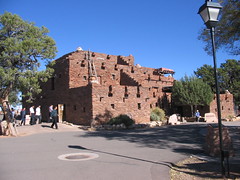
Currently a part of the building hosts a souvenir shop where all kinds of Made in China trinkets are sold to visitors and tourists.
Tusayan Museum, Grand Canyon
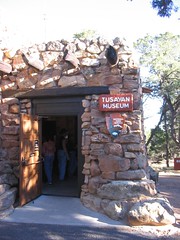
Though the exteriorl of this building makes it appear like a ramshackle hut, the insides have all the modern comforts such as fire place, air conditioning etc. It is definitely worth a visit.
Thursday, June 25, 2009
Grand Canyon: A preferred getaway

In 2007 when I landed in the US one of the first major destinations I visited was Grand Canyon.
When I saw the extreme level of commercialization and urbanization that have been put in place around the Grand Canyon, I was rather disappointed. I expected to find some Native Americans still attired in traditional clothes, riding horses and manning visitors. But things have changes quite a bit and I don't know whether it is for the better.
One way to look at it, with modern infrastructure, lot more people visit the place and the state and hundreds of people earn their living thanks to this. This provides access to the old, weak and challenged. But on the other side, considering the nature and the original inhabitants (Native Americans), the commercialization has pretty much uprooted them people and transformed the nature. I wonder what it will be like after 20 years.
Tuesday, September 16, 2008
Wild Flowers of Arizona
One of nature's creations and human modifications that have astounded me, captured my imagination and caught my attention always is the Plant Kingdom. My interest in plants took me towards Botany in my teen and college years. Though I didn't make it my profession, the study of plants has continued to interest me. So whenever I travel I try to capture these subtle life forms and their beautiful inflorescences which are often the subject of poetic verses and descriptions of writers. Anyway I would not like to bore you with eloquent prose too much.
These pictures were shot in the Fort Bowie vicinity in Arizona which I visited couple of weeks ago when we drove to Los Angeles from Dallas. 
A caterpillar which is the middle phase of the lifecycle of a butterfly

A flower yet to open up and soak in the light from the sun rays

Ready and receiving light from sun and waiting to germinate and give rise to offsprings

A bunch of bright yellow flowers succeeds in cheering you

The bud is slowly but surely blooming

Slowly and steadily, wider and wider the flower blooms

Bright yellow flowers are seen everywhere in the US during summer months

Enroute we stopped by a pista plantation. I had never seen a pista tree or the how the fruit looks like when raw

And here I am photographing the same for others who have not seen a pista tree laden with fruits or should I say 'nuts'
Sunday, August 31, 2008
Fort Bowie, Arizona
During our road trip to Los Angeles we stopped by at Fort Bowie in Arizona. This used to be one of the key links in the days of rail road and when the white European invaders were fighting the Native Americans in a bid to take possession of this continent-sized country. Getting to Fort Bowie involves a 1.5 mile walk through a open grassland surrounded by mountains and one has to ford couple of streams too. Paucity of time prevented us from getting to the actual fort but nevertheless we did about 0.5 miles on the trail and retraced our steps. Here are some pictures of Fort Bowie trail.. 
At the beginning of the Fort Bowie Trail
According to the official site of Fort Bowie National Historical Site, this was the location of immense military action and a location which commemorates the "bitter conflict between Chiricahua Apaches and the U.S. military - a lasting monument to the bravery and endurance of U.S. soldiers in paving the way for settlement and the taming of the western frontier. It provides insight into a "clash of cultures," a young nation in pursuit of "manifest destiny," and the hunter/gatherer society fighting to preserve its existence."The site further states that this site was the center of military operations between the Native Americans and the European Settlers. Quite expectedly the ill-equipped and simple native americans couldn't stand for long against the well equipped and cunning European forces who forced them to surrender in 1886. Did the Europeans leave the surrendered Native Americans alone? No way, in a bid to further humiliate them and alienate them from their land, the Chiricahuas were banished from Arizona to Florida and Alabama.
If I were to inherit this kind of legacy of ruthless murder, plundering and displacement of natives to take over their land and natural wealth to build settlements, I would be totally ashamed of my history. But here this kind of practice of annihilating entire civilisations, cultures and tribes is celebrated and praised. No wonder these people didn't bat an eyelid while dropping the Atom bomb on Japan during WW II or battering up Iraq recently or supporting Islamic militancy in Afghanistan, Pakistan and other parts of the world.
Anyway coming back to Fort Bowie and its serene nature friendly surroundings. Sited in the southeast corner of Arizona state, Fort Bowie's trails range from 4,550 to 5,250 ft asl, and hosts over 65 mammal, 30 reptile and 150 bird species in the area. The trail passes through tall hills and the vast plains are careted with bushes, shrubs and grasses. The entire national park area hosts 471 plant species including several uniquely different flowers, cacti etc. The highest point in the mountain range and national park is a mountain known as Helen's dome. This is a granite rock formation which was used as landmark by travellers during olden days to guide them to the fort.
The entire area is overrun by several streams which run during monsoon and dry up in the warm summer months. There are numerous boards which warn visitors not to go ahead if it is raining or if the road is flooded etc. Apparently when water flows it is quite dangerous.

The first stream which we crossed enroute Fort Bowie

Another stream crossing, there are boards advising people to turn back if these streams are flowing in full capacity

Beautiful flowering plants dot the trail

Arizona is the state of cacti and this is one of the unique varieties found here

Trail facade.... long way through the wilderness to Fort Bowie

Bright yellow flowers cheer the visitors soul

Another uniquely different cactus plant

A 100% dried up tree on the trail

Remains of old buildings along the fort bowie trail

Overview of the Fort Bowie Trail
Saturday, May 17, 2008
Images of Western America
I landed in the US in October 2007 at the west coast, Los Angeles to be precise. From Los Angeles to Texas, I have come a long way and it seems as if my exploration of this continent sized country has stopped there. But believe me the journey so far has taken me through some of the most amazing terrains I have ever seen in my life. The beautiful green mountains of California; stark deserts of Arizona; flat-as-pancake plains of Texas and New Mexico; Ruins of an ancient American-Indian civilisation. The modern highways of America connects every nook and corner of the country. If you have a car and money to pay for gas you can get to any corner of the country. There is no need to walk, you just drive. It is kinda very cushy and comfortable but at the same time sometimes it can be frustrating to see so many cars on the road, when you know for a fact that America has only about 20% of India's population and 500% of India's land area. I sometimes wonder if the entire population of America is always on the road driving their cars... but anyway let us not discuss that, enjoy the pictures below. 
Hills along the road to San Jose

Sea view from Big Sur Highway

Grand Canyon - in all its grandeur

Grapevine lake in Texas

Ducks in a local lake near home, Carrollton, Texas

Walnut Canyon, notice the native Indian dwelling on the hill side

Painted Desert, Arizona - beautiful natural wonder

White Rock Lake in Dallas area, beautiful aqua forte